How to Help Kids Handle Video Game Frustration
Learn how to help kids handle video game frustration when they cry, yell, get angry, or throw controllers, with simple strategies for managing big feelings.
Introduction: Help Kids Handle Video Game Frustration
One of my boys gets so frustrated when he plays video games. If he gets stuck on a level, doesn’t know what to do, or keeps trying and can’t figure something out, he can go from having fun to completely upset so fast. We’ve had tears, yelling, and even a few moments where he’s thrown the controller or the Switch. And while obviously we’re working on not throwing expensive electronics, it made me realize I don’t just want to tell him what not to do. I want to teach him what he can do when he feels frustrated.
That’s actually what led me to write this blog post to Help Kids Handle Video Game Frustration. I think sometimes our first reaction as parents is to blame the video game and take it away altogether. But for some kids, those big reactions are more about how they naturally handle frustration. Instead of avoiding anything that makes them frustrated, I want to use these moments to help my kids learn how to recognize those emotions and manage them in a healthier way.
Getting Frustrated While Gaming Isn’t Necessarily a Bad Thing
I know when you see your kid crying, yelling, or throwing a controller, it’s really easy to think, “See! Video games are the problem. We’re done.” Trust me, I’ve had that thought too. 😂 But getting frustrated isn’t necessarily a bad thing. Our kids are going to feel frustrated their entire lives, and video games can actually give them a pretty low stakes place to practice dealing with it.
Think about what happens in a game. They get stuck, lose, make a mistake, have to start over, try something that doesn’t work, and have to figure out another way. That’s a lot of problem-solving and perseverance happening while they think they’re just playing.
And there is actually research behind some of this. One large supported study looked at more than 2,000 kids around ages 9 and 10 and found that kids who played video games performed better on certain tests of working memory and impulse control. That doesn’t mean video games caused those differences or that more gaming is always better but it does remind us that gaming isn’t automatically bad for kids either.
So instead of immediately taking the game away because my child gets frustrated, I’m trying to look at it as a chance to teach him: Okay, you’re frustrated. What can you do with that feeling? Because today it’s a video game. Tomorrow it might be homework, sports, friendships, or something else that doesn’t go his way.
Teach Kids What to Do When a Video Game Gets Frustrating
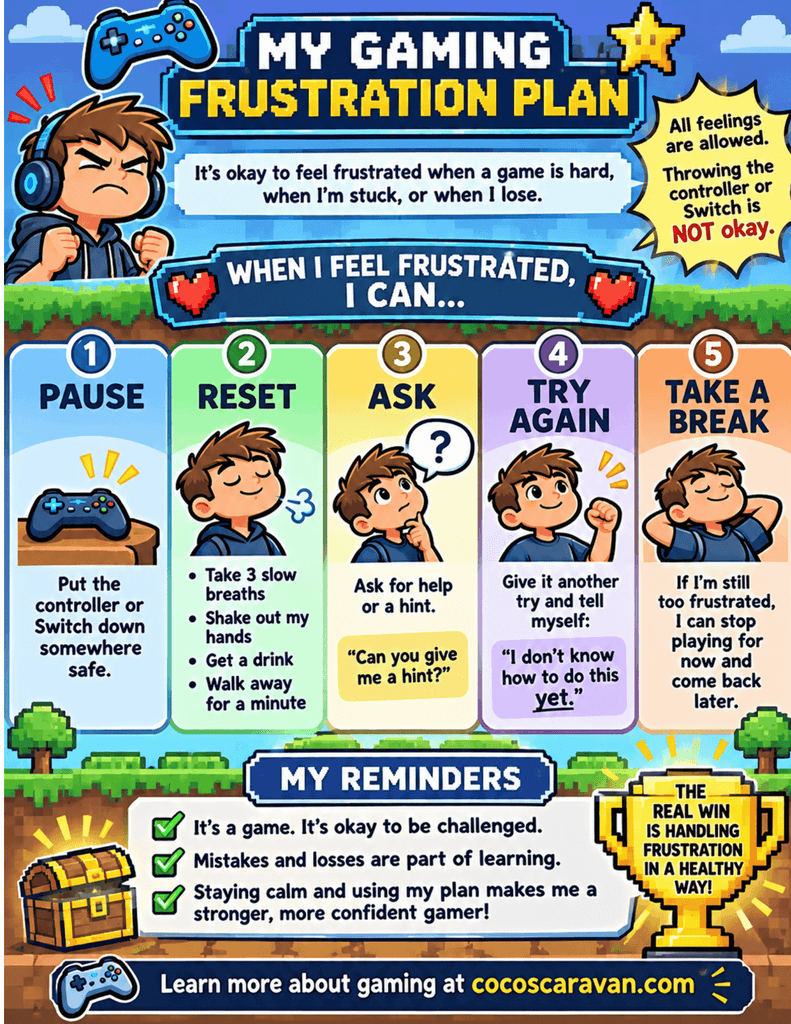
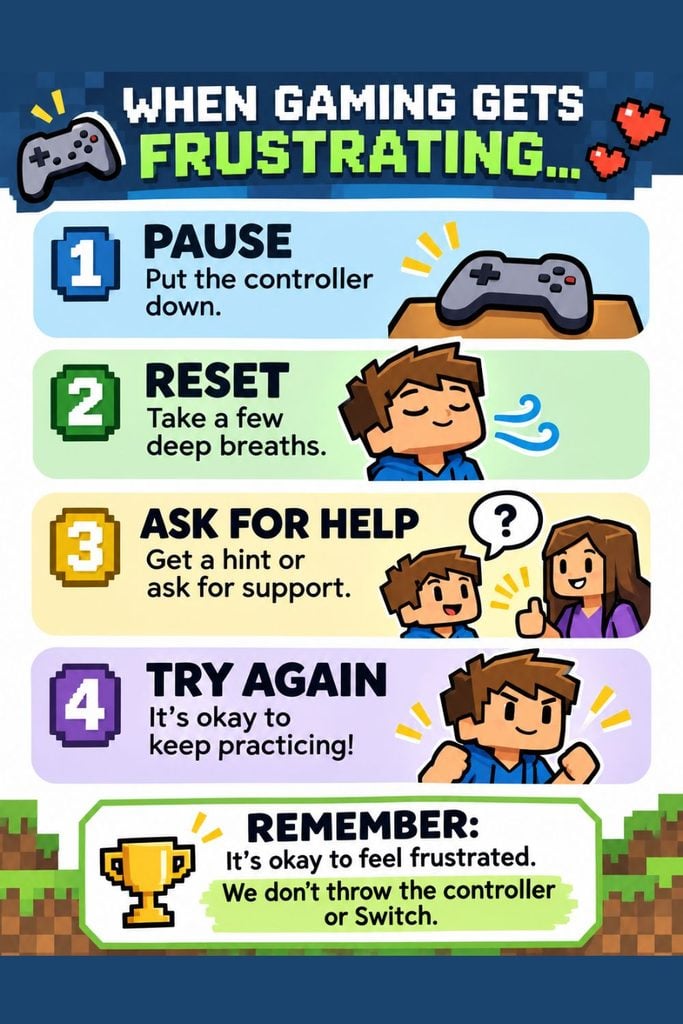
This was the biggest thing I realized with my son: I kept telling him “Don’t throw the controller” or “You need to calm down,” but I wasn’t really giving him other options. Kids need to actually learn what they can do when that frustration starts building. These are the steps we’ve been working on:
- Notice the feeling. Start by recognizing it: “I’m getting frustrated.” Just being able to name the feeling is a great first step.
- Pause and put the controller down. If you can feel yourself getting really mad, pause the game and put the controller or Switch somewhere safe. Especially if you’re starting to feel like you want to throw it!
- Reset your body. Take a few deep breaths, shake out your hands, stand up and stretch, get a drink of water, or walk around for a minute.
- Ask for help. It’s okay to say, “I don’t know what I’m supposed to do. Can you help me?” Sometimes all they need is a little hint to get past whatever has them stuck.
- Try again. Once you’ve calmed down, give it another try. We like changing “I can’t do this!” to “I can’t do this yet.”
- Know when to take a break. Sometimes you’re just done, and that’s okay too. If the game isn’t fun anymore and the frustration keeps building, walk away and come back to it later.
The goal isn’t for them to do all of these perfectly every time. We’re just giving them a few tools to choose from so eventually their first reaction to frustration isn’t throwing the controller.
Print This: What to Do When Gaming Gets Frustrating
Feelings Are Okay, Throwing Controllers Isn’t
One thing I really want my boys to understand is that it’s okay to be frustrated. It’s okay to be mad. It’s even okay to cry. I’m not trying to teach them to push those feelings away I want them to learn what to do with them. The boundary in our house is that you can feel as frustrated as you need to, but you can’t throw the controller, slam the Switch, hurt someone, or break things because you’re mad. The feeling isn’t the problem; it’s how we choose to react to it that we’re working on.
Practice These Skills Before Your Child Gets Upset
The best time to teach these skills is before your child is in the middle of a meltdown. Talk about what they can do when they’re calm, and even practice it together. Have them pretend they’re stuck on a level and getting frustrated, then practice putting the controller down, taking a breath, or asking for help. It’s a lot easier for kids to remember what to do when they’ve already practiced it without all those big emotions getting in the way.
Praise How They Handle Frustration, Not Just the Win
I’ve also been trying to pay more attention to how my boys handle the hard moments, not just celebrating when they finally win. If they get stuck and keep trying, ask for help instead of getting angry, or recognize that they need a break, I want to point that out. Something as simple as, “I saw how frustrated you were, but you put the controller down and took a break. That was a really good choice,” helps reinforce the behavior I actually want them to learn. Winning the game is fun, but learning how to handle yourself when you don’t win is an even bigger win.
What Should Happen If My Child Throws the Controller?
For us, throwing the controller or Switch means you’re done playing for that gaming session. I don’t make it a huge punishment or take video games away for a week. I want the consequence to make sense: if you’re too frustrated to handle the gaming equipment safely, then it’s time to be done for now. I might say, “It’s okay that you’re mad, but throwing the controller tells me you need a break from the game.” Once everyone is calm, we can talk about what happened and what he could try next time. The goal isn’t to punish him for getting frustrated it’s to teach him that big feelings are okay, but we still have to make safe choices with them.
Video Games Can Help Kids Practice Handling Big Feelings
This is actually one reason I’ve started looking at gaming frustration a little differently. Video games give kids a pretty safe, low-stakes place to practice losing, making mistakes, getting stuck, trying again, and asking for help. Instead of removing the game every time those big feelings show up, we can use those moments to teach them how to work through frustration. Today it’s a hard level in a video game, but those same skills can help when it’s homework, sports, friendships, or anything else that doesn’t go their way.
When Video Game Frustration Means It’s Time to Stop
Sometimes a break really is the answer. If my child keeps getting more upset, can’t calm down after pausing, is yelling or being unkind, or just isn’t having fun anymore, that’s usually a sign we’re done with the game for now. I want my kids to learn that choosing to walk away when something is making you too upset is actually a healthy response. The game will still be there later, and sometimes a little space is exactly what they need to come back and try again with a clearer head.
Family Gaming Rules